


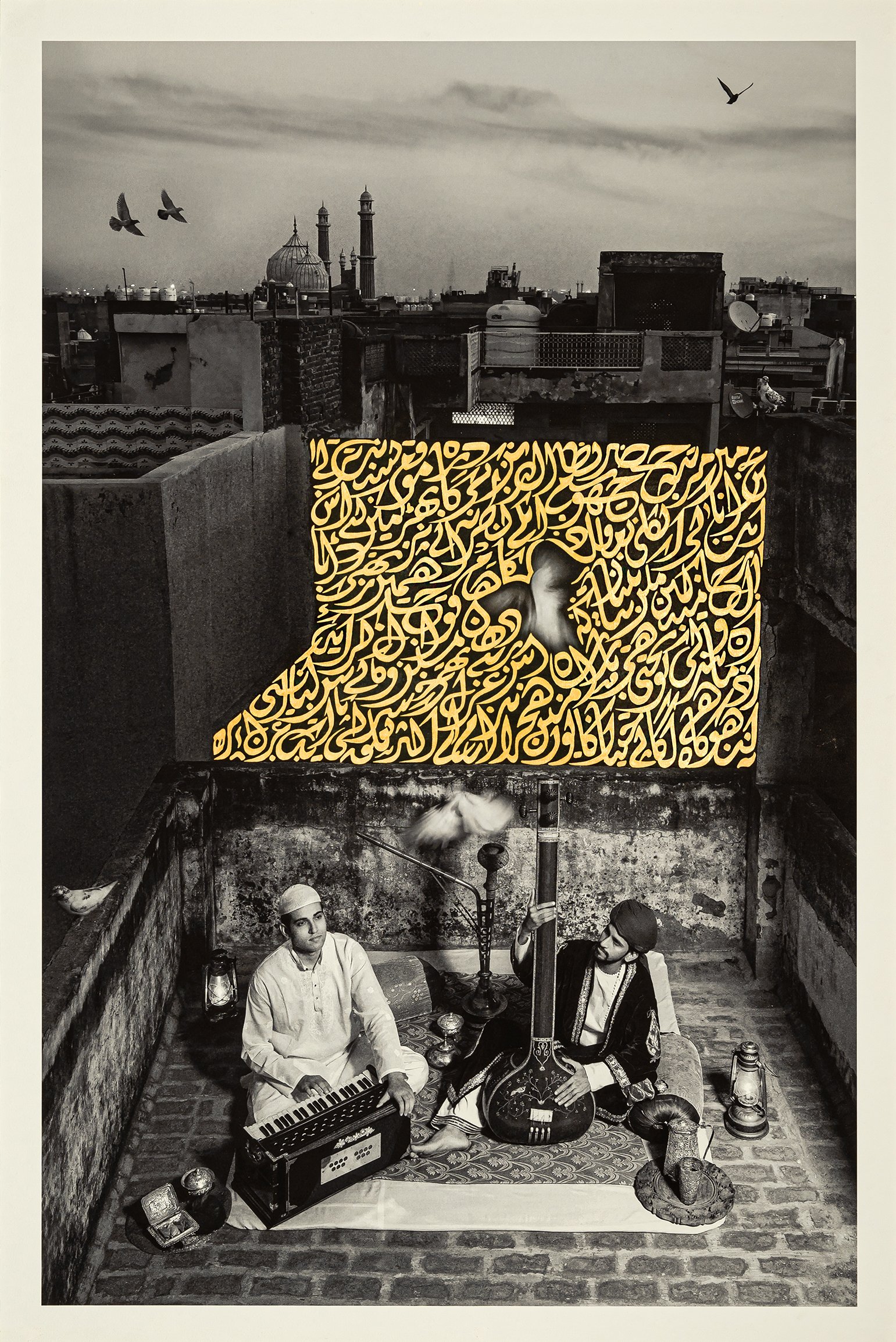

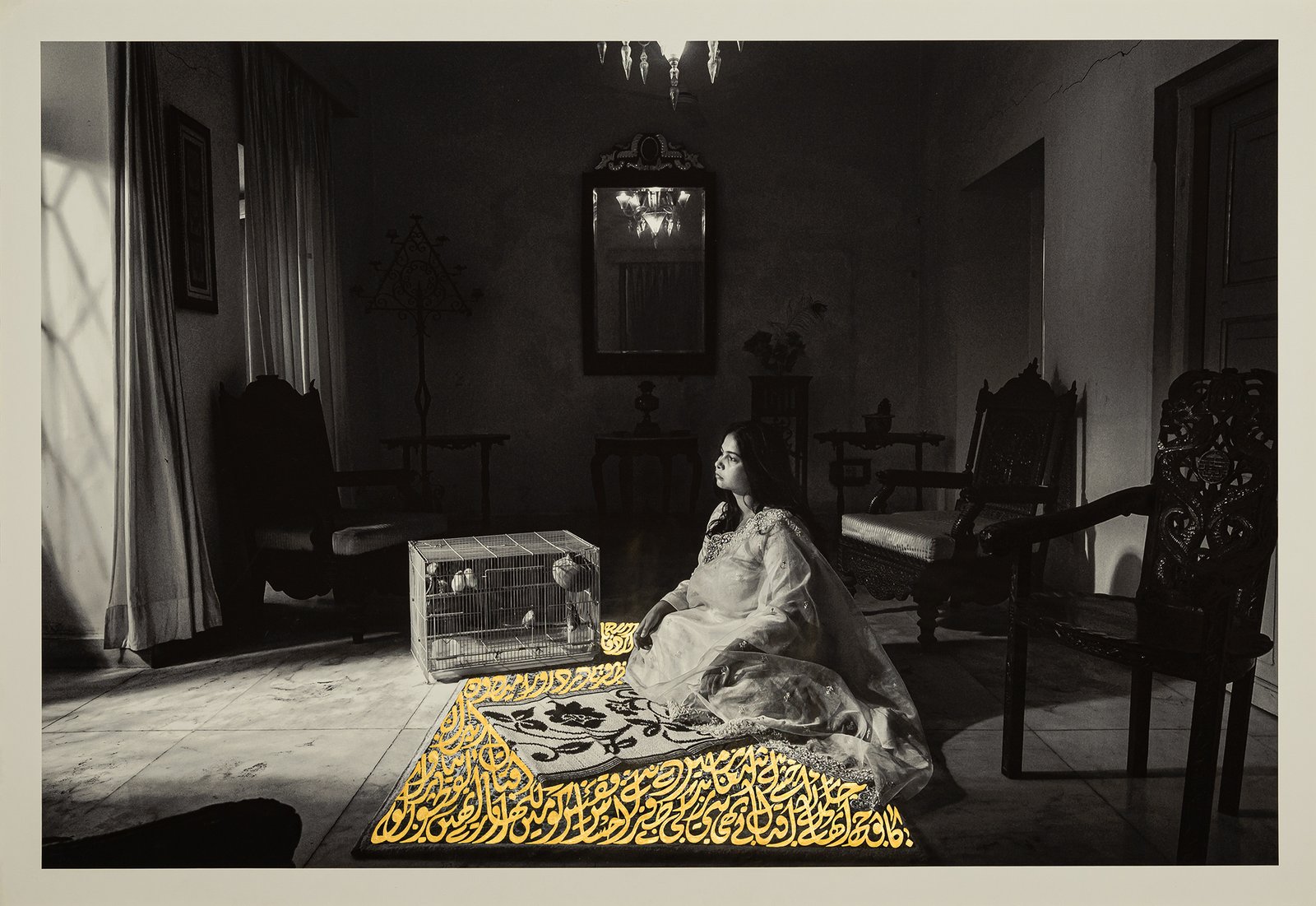
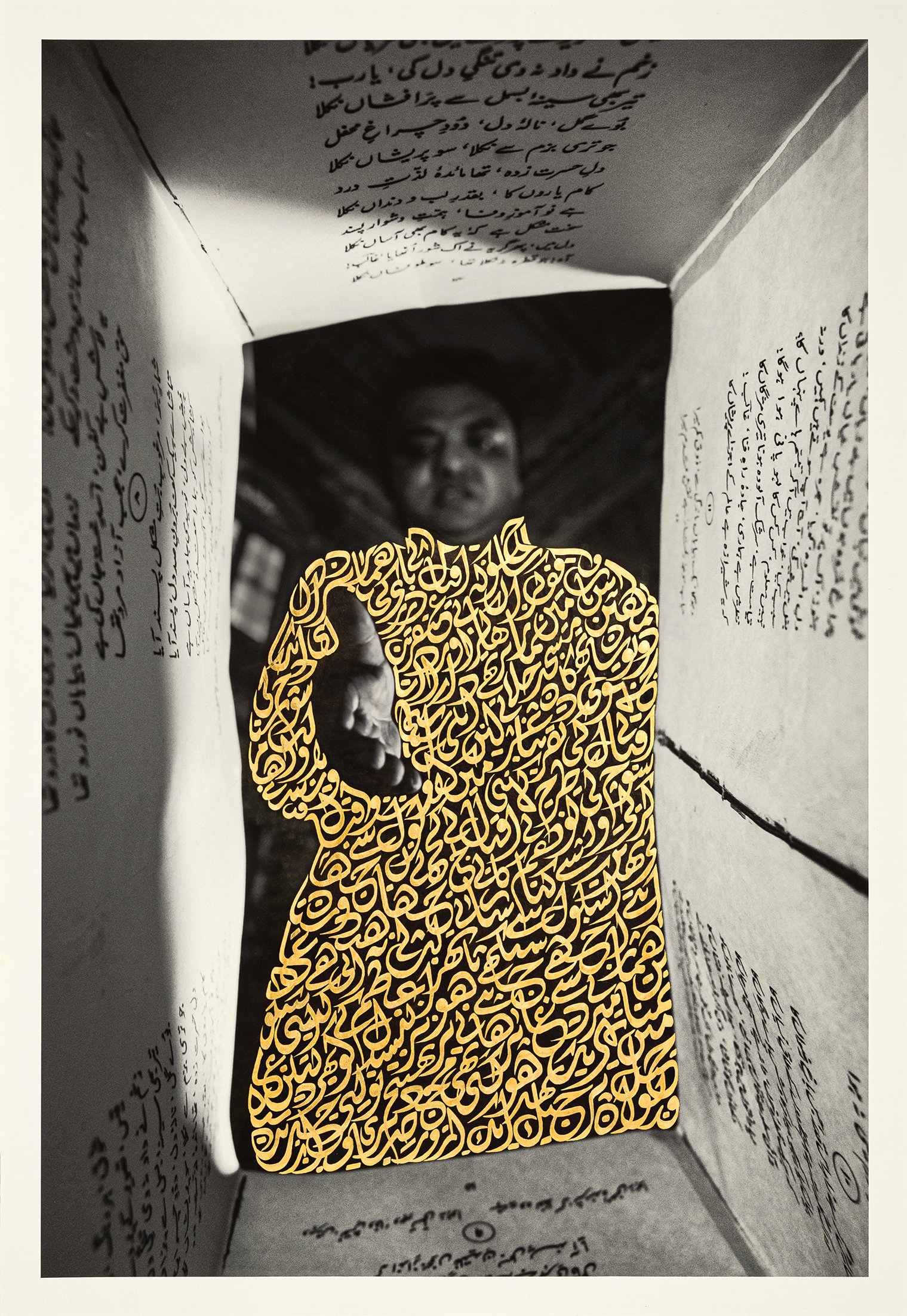

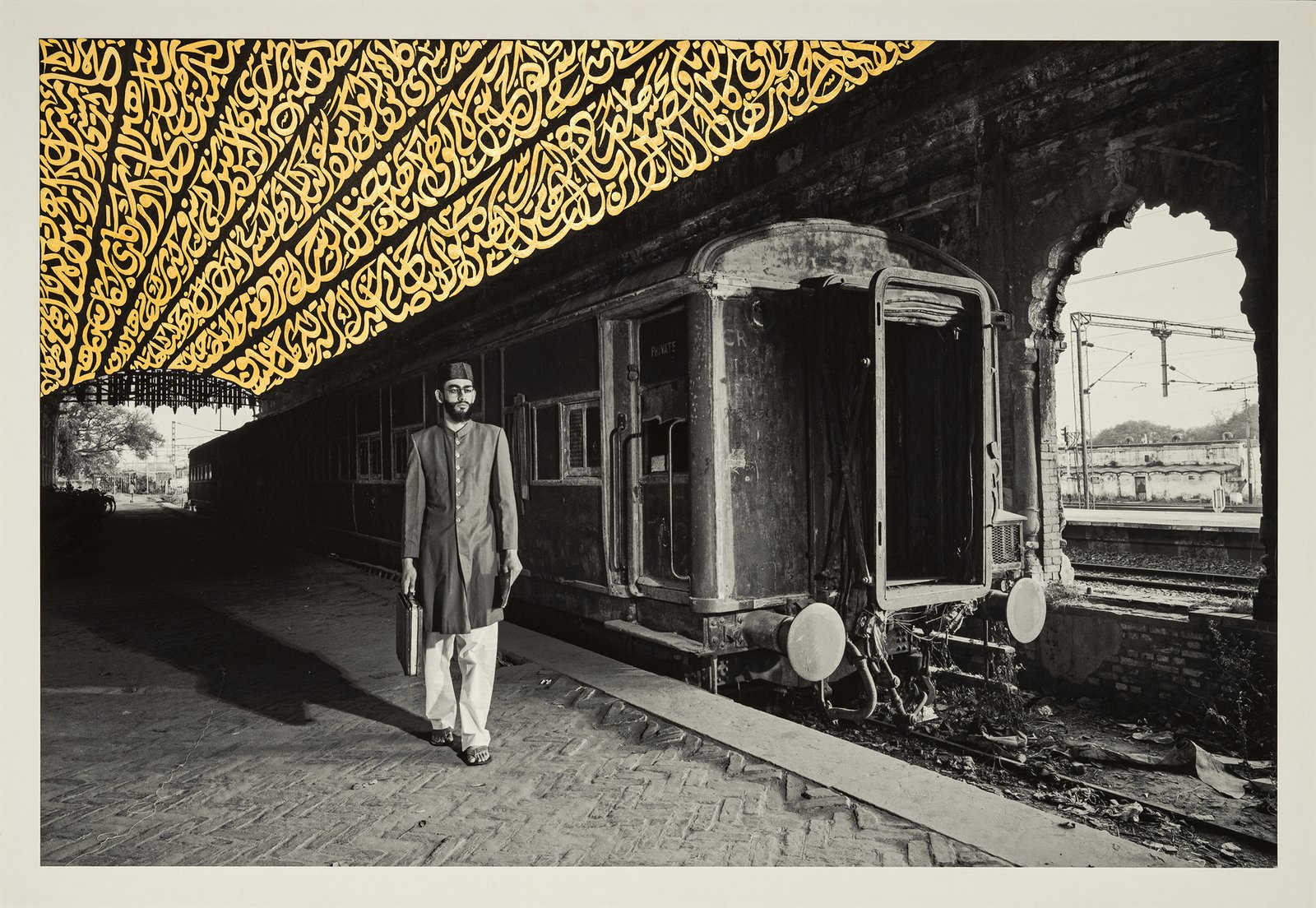

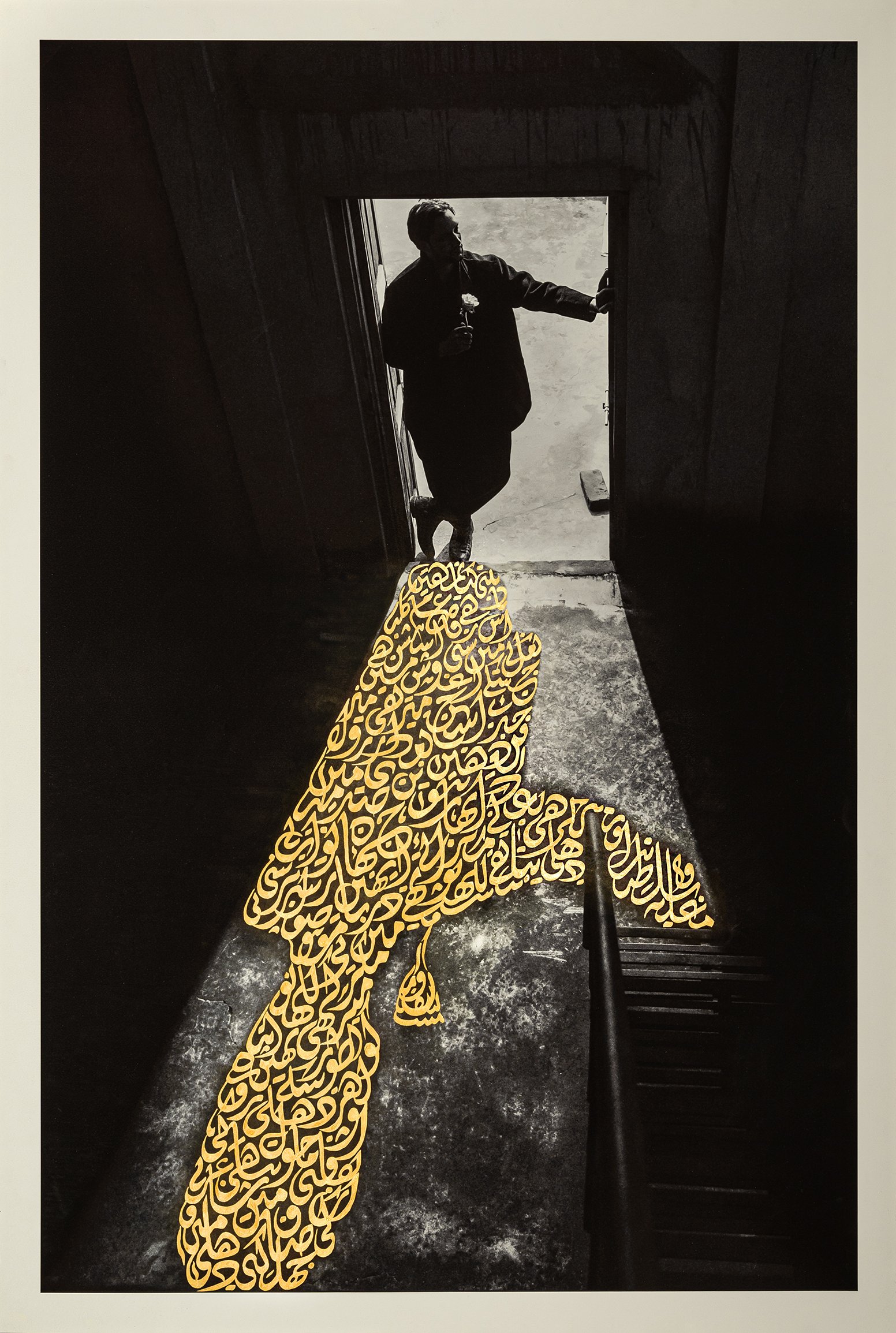


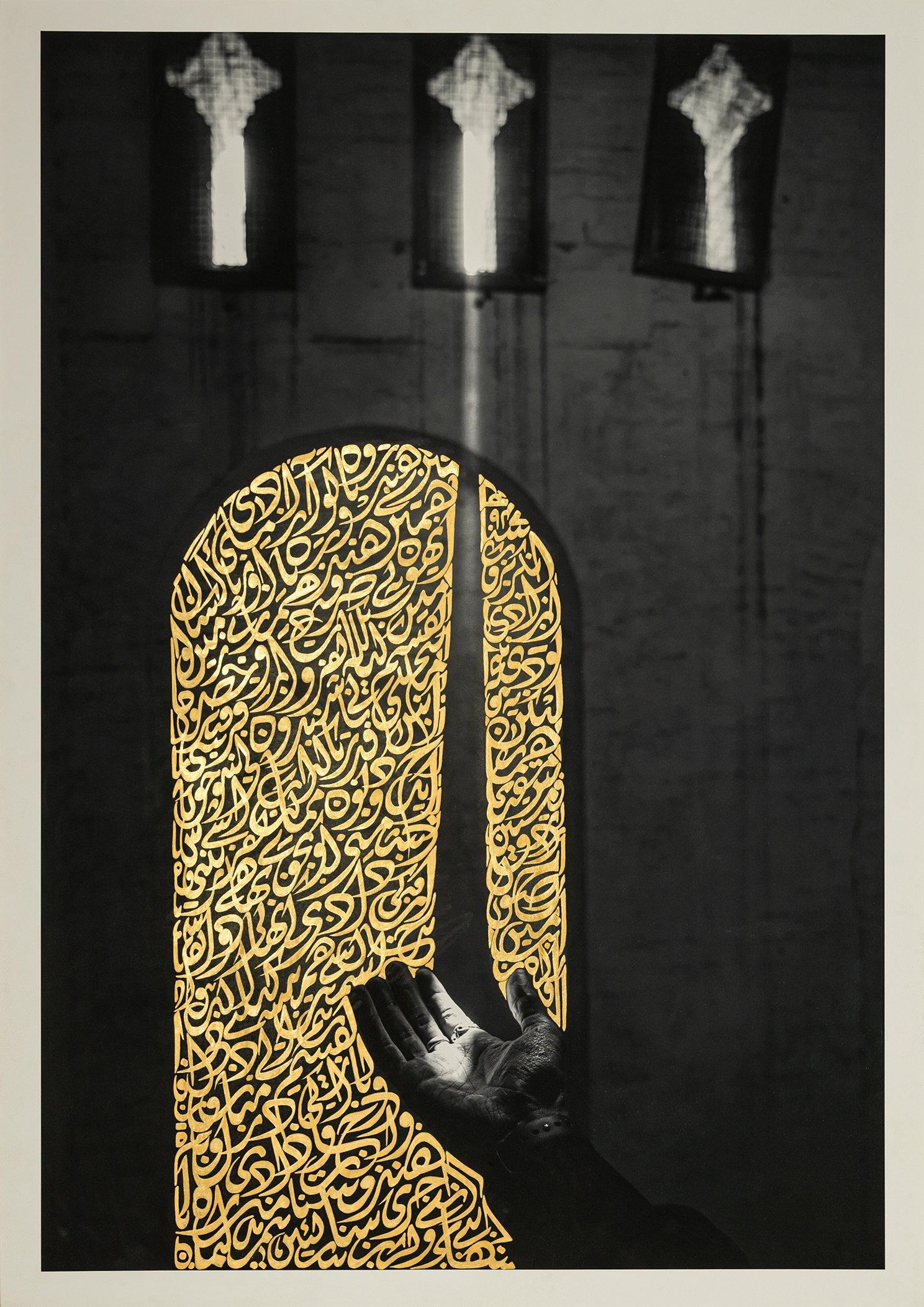


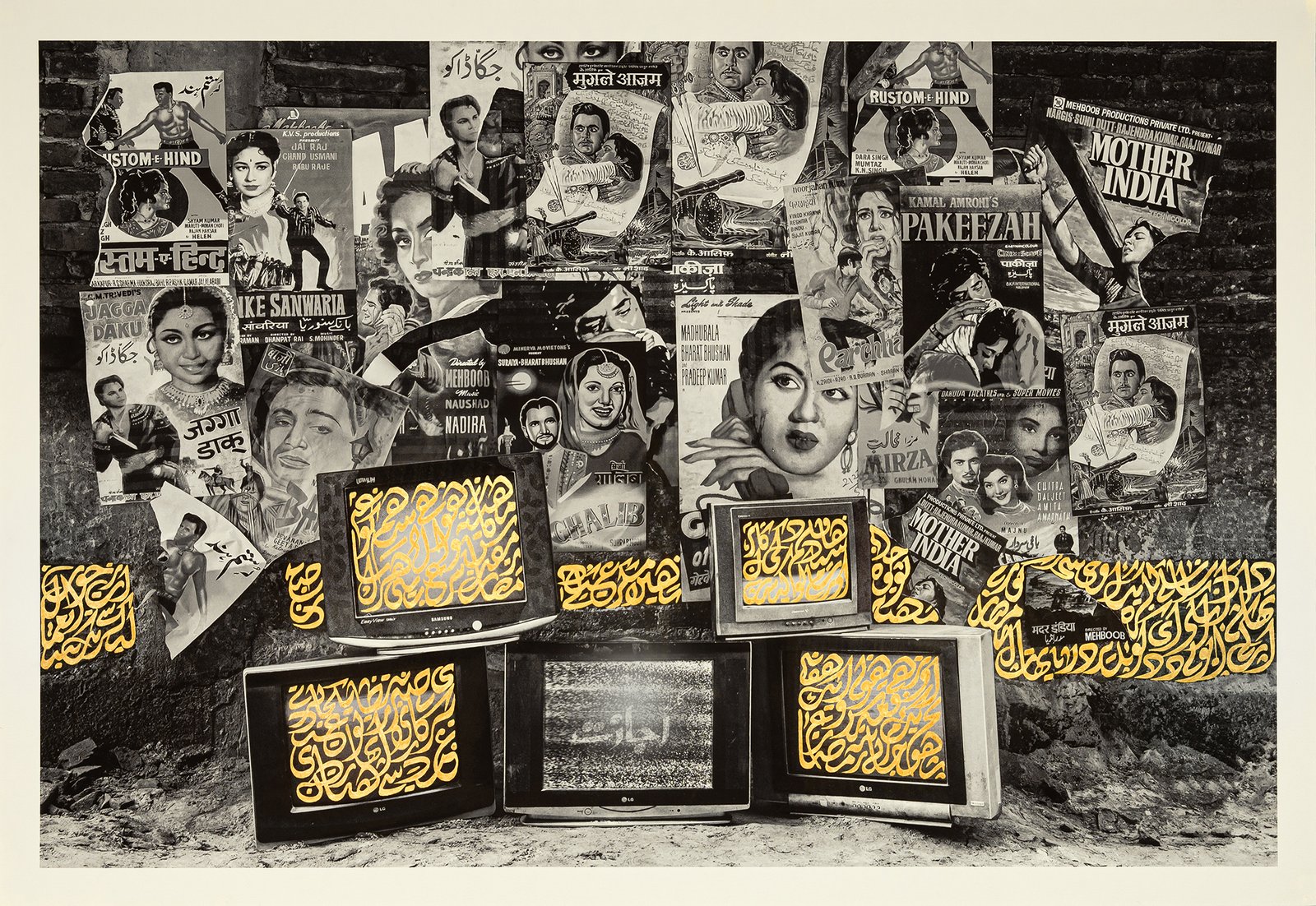


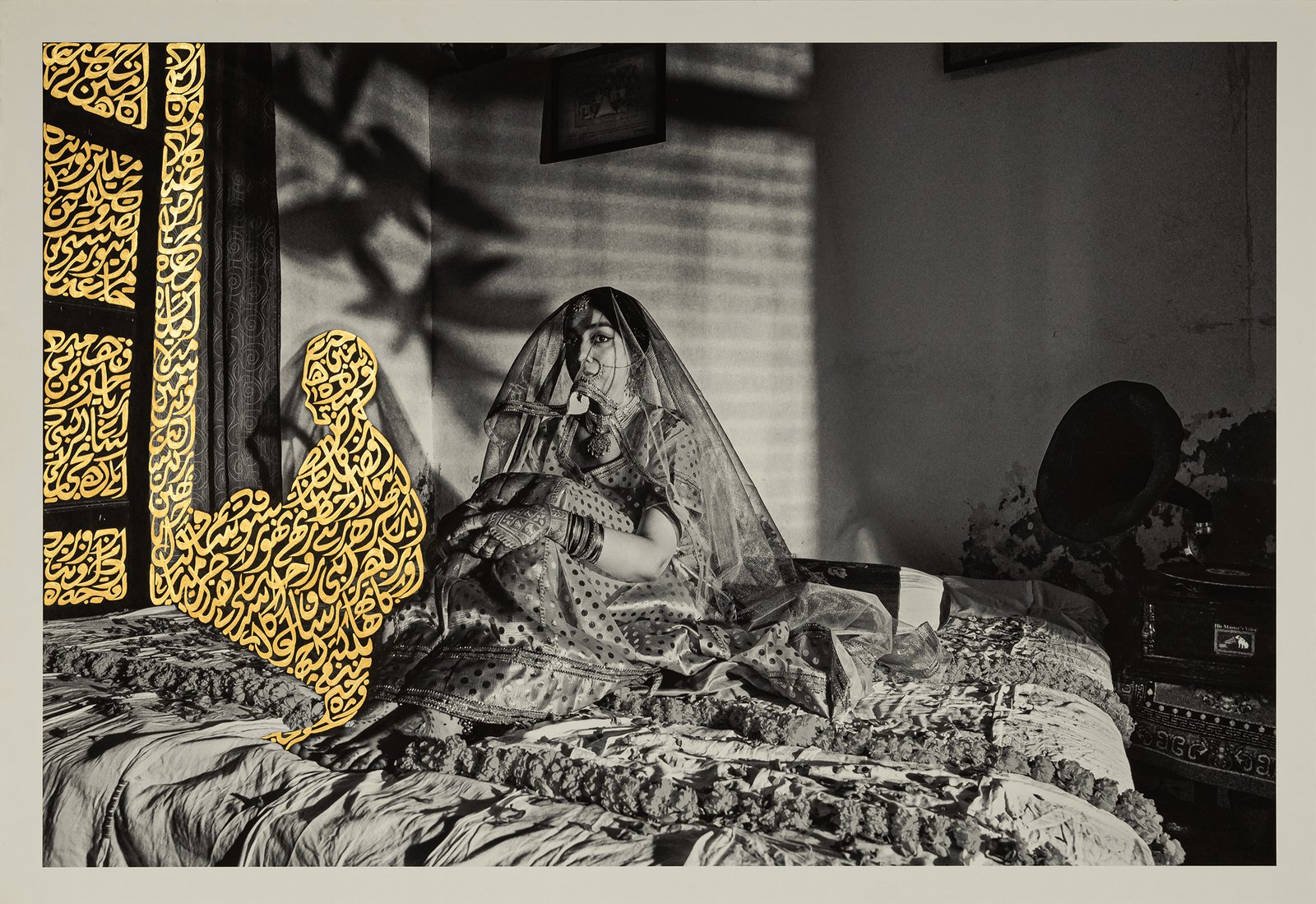
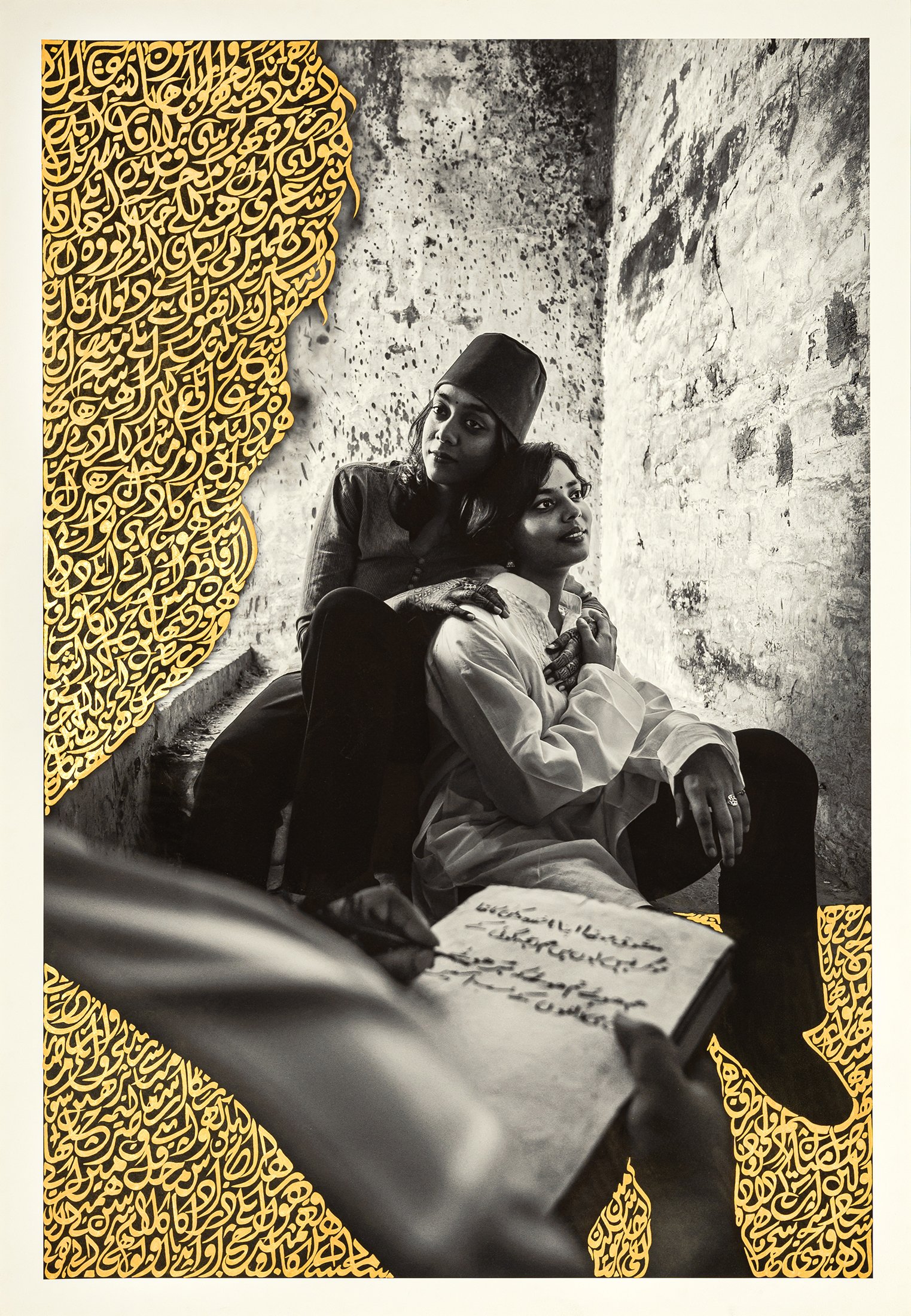
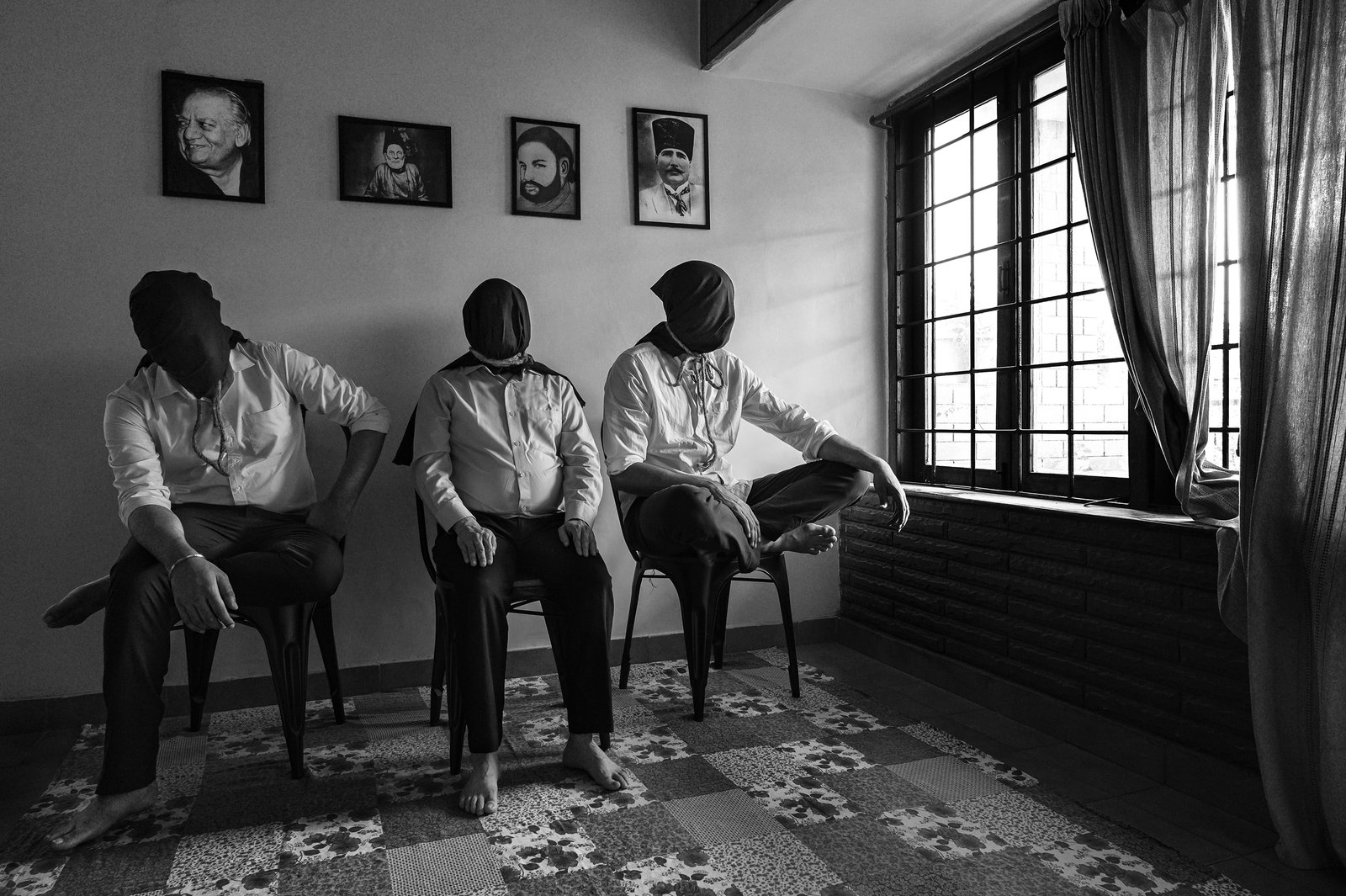

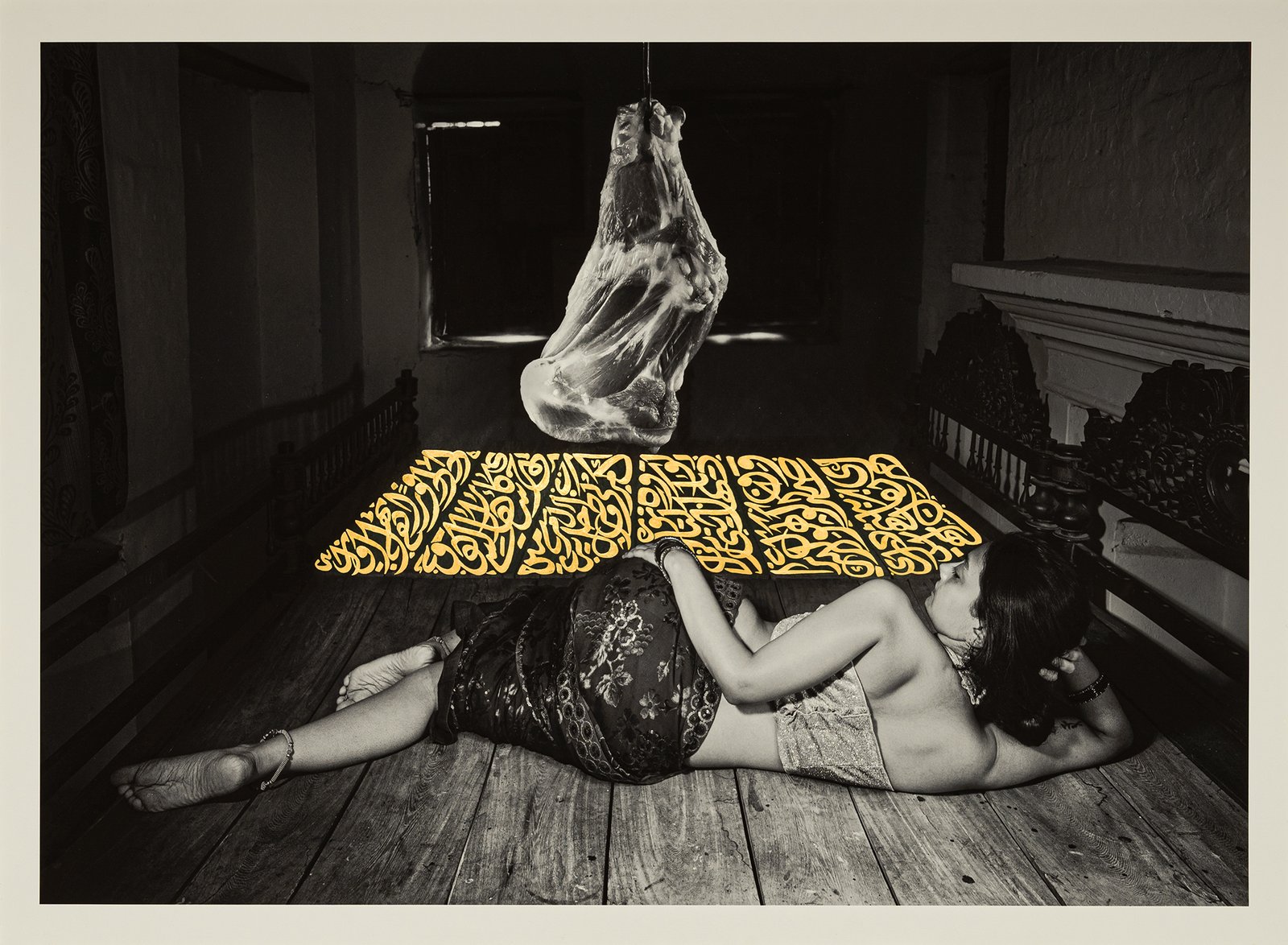


Zarrēn Payaam-e-Urdu: The Aureate Message of Urdu is an artistic evocation of the extraordinary richness of the Urdu language as a shared cultural heritage shaped by centuries of literary, artistic, and secular exchanges across the Indian subcontinent. The project is an act of ‘beautiful resistance’ to the manner in which Urdu is being marginalised and selectively erased by the pressures of sectarian extremism in contemporary India. Through constructed photography, Nasta’liq and Ta’liq calligraphy, and 22 karat gold gilding, the project offers a contemporary interpretation of the voices and poetic forms that have shaped Urdu’s literary imagination across India and Pakistan.
Structured around a fictional letter from a father to his daughter, Zainab, the project unfolds through personal memories, storytelling, and intergenerational dialogue, beginning with her discovery of her grandmother’s old books and handwritten letters. The work traces Urdu’s layered cultural history, from its early development through the confluence of Persian, Arabic, Turkic, and regional Indic traditions to its evolution across poetry, politics, literature, cinema, popular culture, and contemporary digital expression. The golden calligraphy is not intended as ornament alone, but as a gesture of reverence towards a language whose literary traditions have profoundly shaped the linguistic and cultural history of the Indian subcontinent. Each artwork sits at the intersection of memory, imagination, and political consciousness, held together by Urdu as an inheritance and an expression of cultural identity, confronting the forces of erasure while insisting on the language’s continued presence.
The project has been developed with the generous support of Ms. Shabana Faizal, the Faizal and Shabana Foundation, and Qissagoi. The installation design has been developed in collaboration with architect Yusuf Ahmad.
Zarrēn Payaam-e-Urdu has been inspired by the life of Dr. Afzal Ahmad, the artist’s grandfather, and the archives of his literary organisation, Anjuman-e-Arzoo. It is a series of forty artworks that brings contemporary photography into dialogue with traditional craftsmanship. The project works with some of the last remaining practitioners of the crafts historically sustained by Muslim artisan communities, practices that gradually diminished through the social, political, and cultural ruptures that followed the Partition of India and Pakistan.


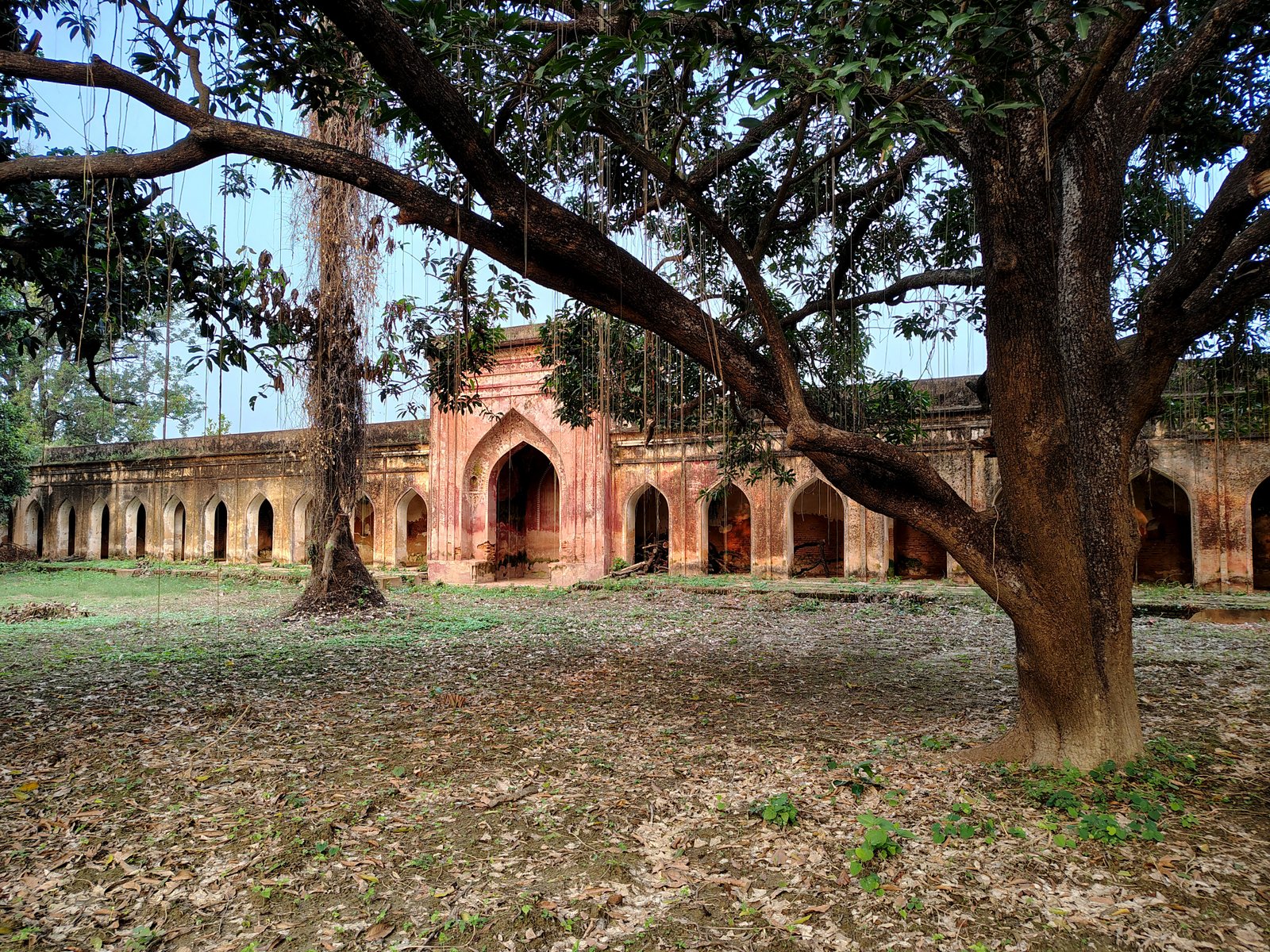


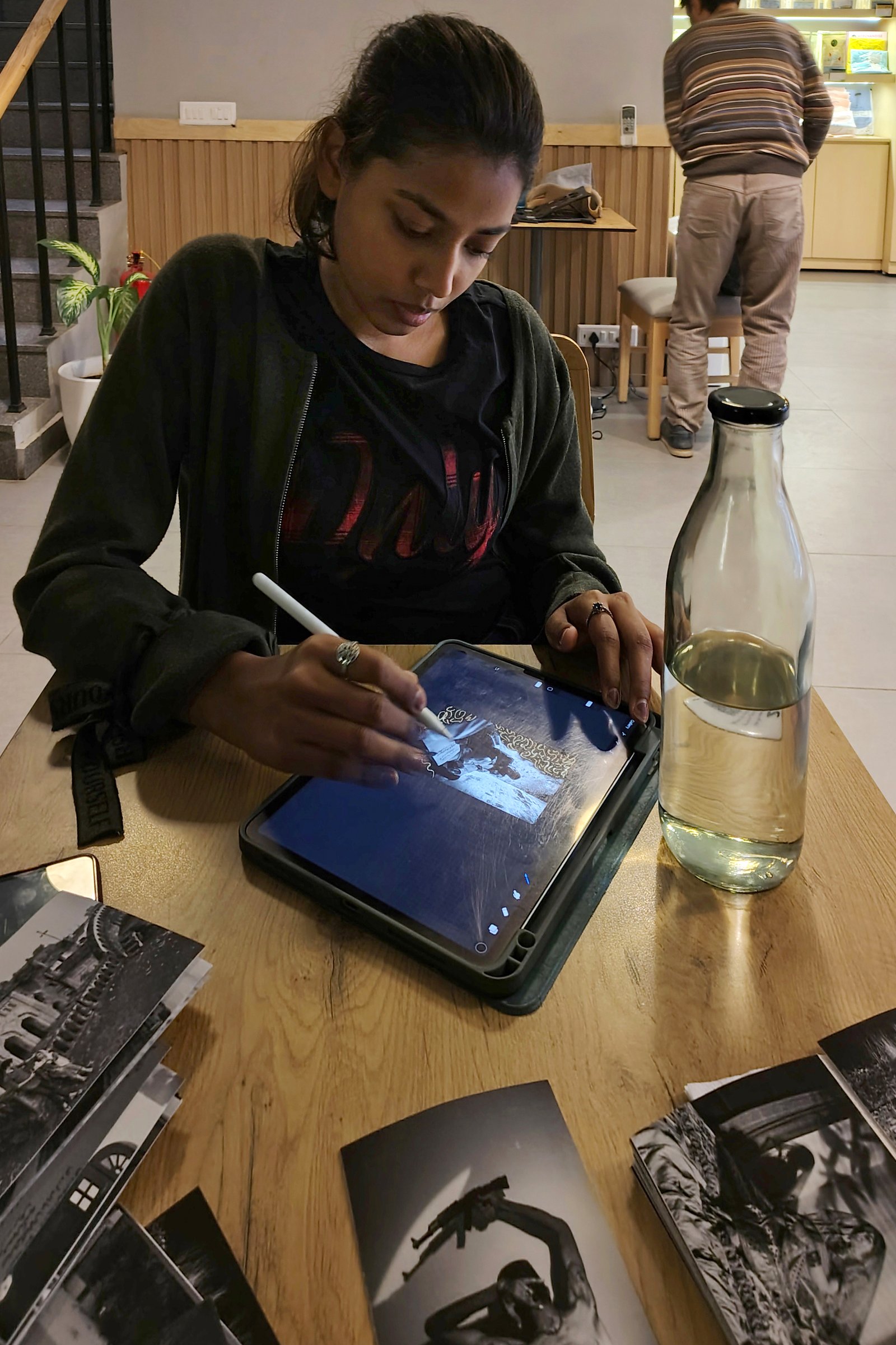


The process began with research in libraries and Urdu institutions, with family archives, Hindi and Urdu cinema, oral histories, and travels through towns and old cities across Northern India, where fragments of the language’s past still survive. These findings shaped the visual vocabulary of the project.
The first phase of the project focused on constructed photography. In the second phase, Urdu calligraphy was integrated into the photographs, guided by my artistic vision. Indian calligrapher Mohammad Ali manually inscribed the script in Nasta’liq and Ta’liq, using a bamboo qalam and a special ink prepared by me. This expanded the visual narrative of the project through a fictional letter written collaboratively by Nimra Vizarath, Sabika Abbas Naqvi, and myself.
Once the calligraphy on the photographs was completed, the works travelled to Jaipur, where fourth-generation Mughal miniature artist Riyaz Uddin handpainted the paragraphs of the calligraphed letter on the photographs in 22 karat gold. In the final phase, the works were sent to Hyderabad, where they were entrusted to one of the last remaining artisans practising the traditional techniques of Ghisai and Ghutai, using a 2-inch Mughal knife. I incorporated this extended process to refine the surface of the gold to achieve a subtle, archival glow reminiscent of illuminated manuscripts.
Project Curator: Beatrice Campi
Project Team: Nimra Vizarath, Sabika Abbas, Ashi Gupta, Mohammad Razi, Asad Ali, Wamiq Zia Dehlvi, Kamil Ali, Arsalan Hashmi, Yuman Faizan, Sharique Mohammad Aziz, Bhavya Singh, Yashas Dev, Niharika Grover, Ali Shah Mohammad, Narender Kadian and Karan.
Credits: Dr. Ali Khan Mahmudabad and Mahmudabad Estate, Shamsi Abbas, Harshit Singh, Idris Ahmad, Sana Masroor and Sharif Manzil, Shan Bhatnagar, Kushal Kapoor, Ayesha Ashraf and Sihali Estate, Zeenat Suhail, Shivika Singh and Shivgarh Estate, Archaeological Survey of India, Humayun Ali Nasir, Taqi Abbas, Maroof Culmen, Abu Sufiyan, Delhi Gharana, Qazi Danish, Abdul Rehman, Gurleen Arora, Khairabad Estate, Niba Mirza, Rageshree Ranade and Aarohi Mishra.
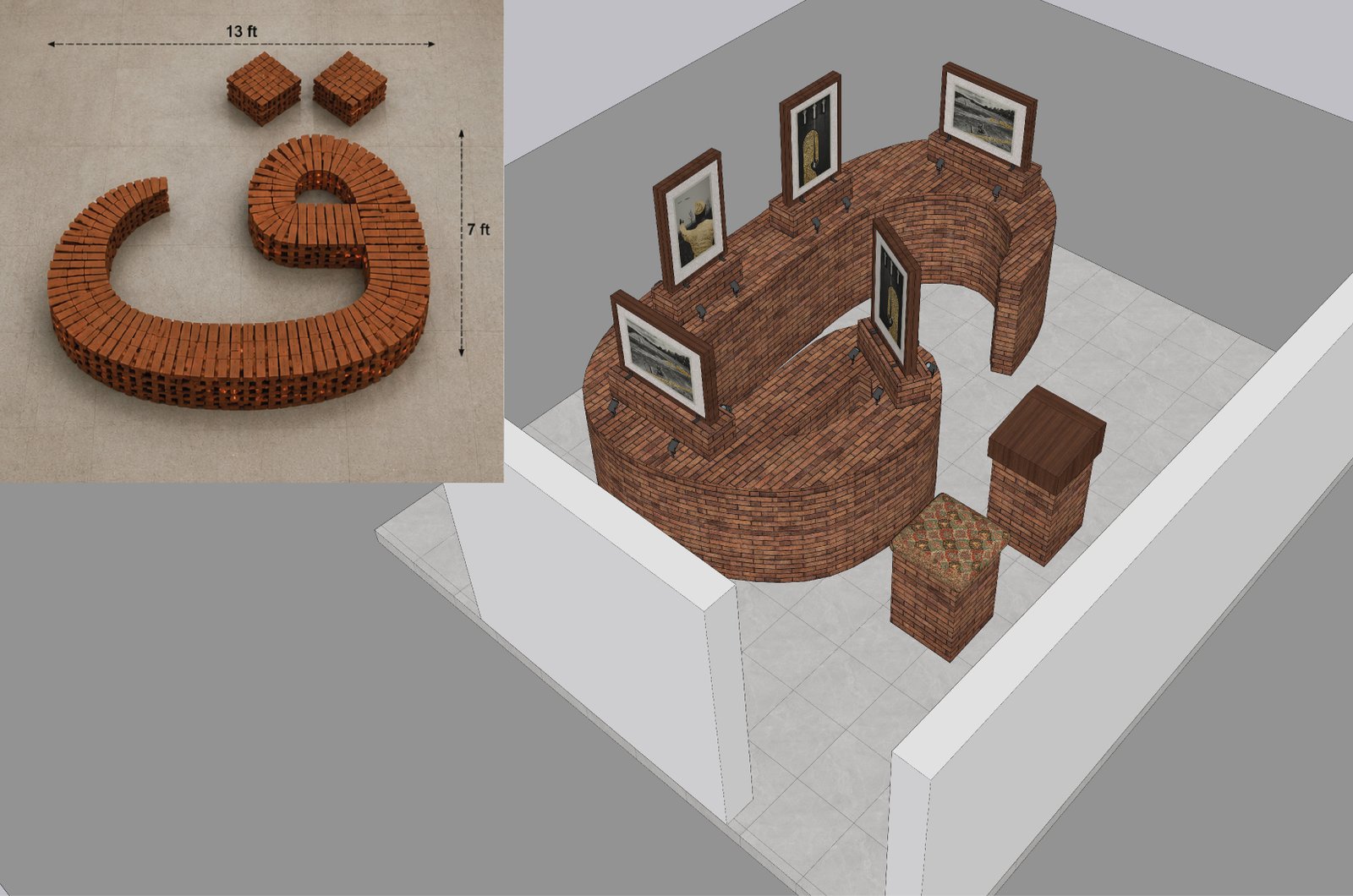
The installation takes the form of the Urdu alphabet Qaaf (ق), inspired by my first encounter with the archives of Anjuman-e-Arzoo, an Urdu literary and cultural organisation my grandfather founded in Lucknow in 1949.
During the COVID-19 pandemic, I left Delhi and returned to my ancestral home in Lucknow. While searching for my grandfather’s Rolleiflex twin-lens camera, I unexpectedly discovered a calligraphed painting by him. It depicted the alphabet Qaaf (ق), hand painted using a traditional bamboo pen and ink. This discovery led me to explore his office and room, where cupboards had remained unopened since his demise. Opening them revealed his organisation’s history, its extensive archive, his penned Urdu books, and his personal collection.
For the Installation, I transformed the Urdu alphabet Qaaf (ق) into an architectural structure that invites visitors to physically engage with the project, my family’s cultural inheritance and the histories recorded in these archives. Designed to be experienced from all sides, the installation allows visitors to walk around the structure, and experience the artworks from a 360-degree perspective.
The structure is constructed from Lakhori bricks sourced from old havelis and homes in Lucknow that are being dismantled to make way for new houses and apartment buildings. Artworks in wooden frames are positioned along the upper surface of the brick structure, turning the alphabet into both an architectural form and a display for the project.
The two Nuqtas (dots) of the alphabet are designed as spaces for resting and listening. On one, I have placed a writing desk belonging to the Munshi Premchand Estate in Varanasi, on loan for the installation. On the other, a soft cushion invites the visitors to sit. A pair of headphones, connected to a tablet concealed within the desk, allows visitors to sit and listen to a recorded reading of the letter in the voice of Urdu scholar Nimra Vizarath.
Ultimately, the installation becomes a point of origin, a vessel of cultural memory, and a space through which I invite visitors to explore my relationship with the Urdu language and its cultural inheritance.
Roman (Urdu)
The letter has been edited and translated in Nasta’liq and English by Urdu scholar Nimra Vizarath.